Data copy leads with a statistic or a big number to make its point. '90% of businesses fail for one reason.' '82% of coaching businesses fail.' 'Five-minute technical responses.' A strong number grabs attention and makes an argument feel grounded. The swipes below show stats used to open a pitch, to prove support claims and to turn proof into something people can see.
A number feels like evidence, even before the reader checks it. A stark statistic in a headline creates tension: if 90% fail, am I in that 90%? That pulls the reader into the solution. Numbers also make vague promises checkable. 'Great support' means little. 'Five-minute technical responses' is a claim someone can test. Stats work best when they are sourced, relevant to the reader and paired with a one-line explanation of why they matter. A big number with no context is just noise. A stat that cannot be traced to a source, or that is stretched beyond what it says, damages trust in everything nearby.
2How to use it in your copy
Find one number that proves your main point.
Check and keep the source.
Put the number where the reader sees it first.
Add one line on what it means for them.
Use only a few stats so each one stands out.
3Mistakes to avoid
Quoting a statistic with no source.
Using a big number that has nothing to do with the reader.
One saved ad, email or sales page every week, with a short note on why it works and how to use the idea in your own copy. Free, one email, unsubscribe any time.
Sent with Systeme.io, which we also recommend for building pages like these.






 Scaling Retreat's S.C.A.L.E. Method event pageA stark claim that 90% of businesses fail for one reason opens the page and pushes entrepreneurs to attend.
 Helpjuice's WOW Care support sectionThree big numbers, each with a one-line reason, turn a vague promise of good support into checkable claims.
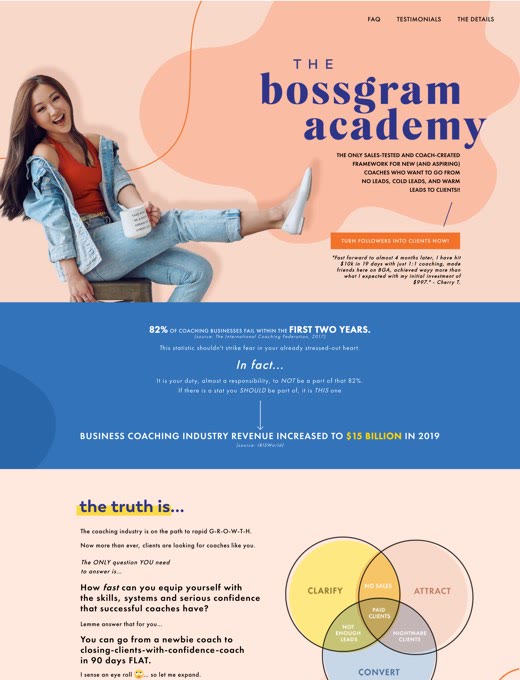 Bossgram Academy coaching landing pageA client result is followed by a sourced stat that 82% of coaching businesses fail, setting up the course.